Understanding the "Create 837 Transaction Sets" Window |
  
|
Understanding the "Create 837 Transaction Sets" Window |
|
In this chapter, you can find the descriptions for each of the 11 sections within the "Create 837 Transaction Sets" window. See Each section and its fields below.
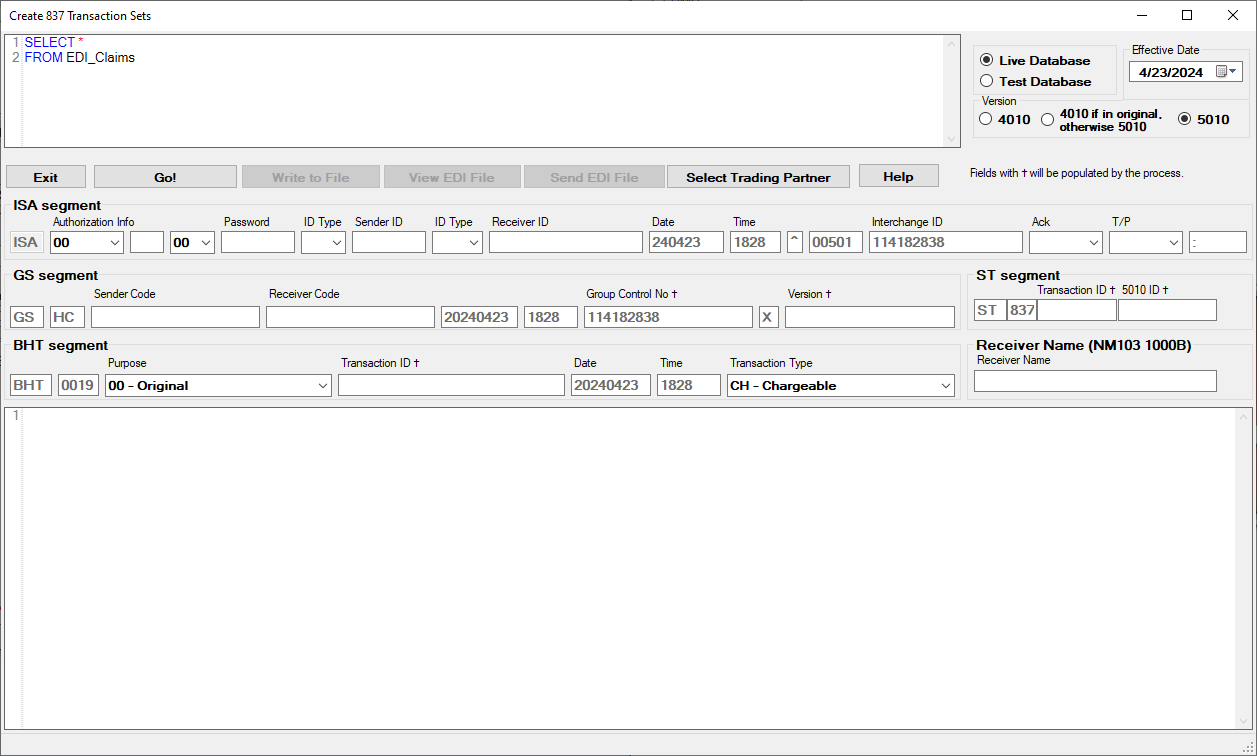
The "Create 837 Transaction Sets" window.

The "Query Field" box.
This field is located in the top left corner of the window. It is used to narrow down the records to be written to the EDI files. You can create your own query or you can use the query builder in the exported claims window.
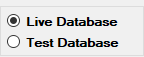
The "Database Status" box.
The Database Status box allows you to choose between the Live database and the Test database as outlined in the data connection setup.
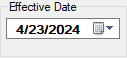
The "Effective Date" box.
The "Effective Date" box allows you to select the effective date of the file. By default, the current date is selected, but you may select another date as needed.

The "Version" box.
The "Version" box allows you to select the version of the resulting EDI file. You have the choice between versions 4010 or 5010. It is generally possible to generate 4010 files from claims that came in 5010 files and vice versa. A third option, "4010 if in original, otherwise 5010," is for claims that came from EDI files and were imported into the database. This would preserve the original version so that a claim that came in an EDI file in 4010 format will be output as 4010 files, while a 5010 file will be output as 5010.

The "Action Buttons" area.
The "Action Buttons" area provide some actions you may take regarding the creation of 837 transaction sets:
oExit — This button will end any process and close the window.
oGo! — This button will begin the process of writing the 837 EDI files in the database.
oWrite to File — This button will bring a drop-down menu to determine the location in which to write the data. You have two options:
§Use default path and names
§Select path and names
oView EDI File — This button allows you to open EDI files within the EDI Viewer.
oSend EDI File — This button allows you to send the EDI file to the selected Trading Partner using FTP as the EDI File Exchange Method.
oSelecting Trading Partner — Once this button has been clicked, a pop-up window will open where you can select your defined Trading Partner.
oHelp — This button will redirect you to the user's manual if you need further assistance.
Note: If you have the EDI Exchange component licensed, you can select the Trading Partner and fill the form with a specific Trading Partner's information.

The different EDI segments available to fill out.
EDI Envelopes are segments that enclose various types of information within. Below you will see the different EDI Envelopes that conform each EDI file.
oISA Segment — The Interchange Control Header (ISA) segment contains the outermost envelope of the EDI file and it represents data that is required to read an EDI file. Listed here are the sender and receiver, the date and time, whether a response is expected and which characters to use as segment, and the element and sub-element separator. The data in black may be changed, while grayed-out data is determined by the Company Setup configurations.

The "ISA segment" box.
oGS Segment — The Group Start (GS) segment contains transaction-specific information, such as which transaction sets are in this file and also information on the creation (Sender code) and consumption (Receiver Code) of the EDI files. Group control number and version will be auto-populated since this information depends on the claim type.

The "GS segment" box.
oBHT Segment — The Beginning of Hierarchical Transaction (BHT) segment further qualifies the claim in the 837 transaction set by specifying whether this is an original submission and whether the claims are chargeable or just encounter records.

The "BHT segment" box.
oST Segment — The Start of Transaction Set (ST) segment lists the transaction set code and a unique identifier for the transaction.
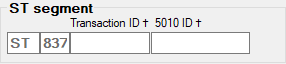
The "ST segment" box.
oReceiver Name (NM103 1000B) — This field will be populated with the information from the Trading Partner's setup information.
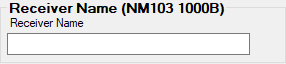
The "Receiver Name (NM103 1000B)" box.
The "EDI Text Box" area.
Within the EDI Text Box, you will be able to see the EDI text displayed. From here, you can write this into the database while still being able to view it.