Selecting a Code Set |
  
|
Selecting a Code Set |
|
EDI relies on transaction code sets. These codes represent longer explanations and descriptions.
The code sets are stored in the file codesets.xml in the Configuration subdirectory:
oThis PC\Window (C:)\ProgramData\HIPAAsuite\HIPAA Claim Attachment Master\Configuration

Path to the Configuration folder for the codesets.xml file.
Note: The folder may be hidden.
To view and/or edit transaction code sets in the HIPAA Claim Attachment Master application, follow the steps below:
1.Go to the "Code Sets" tab in the main menu window.
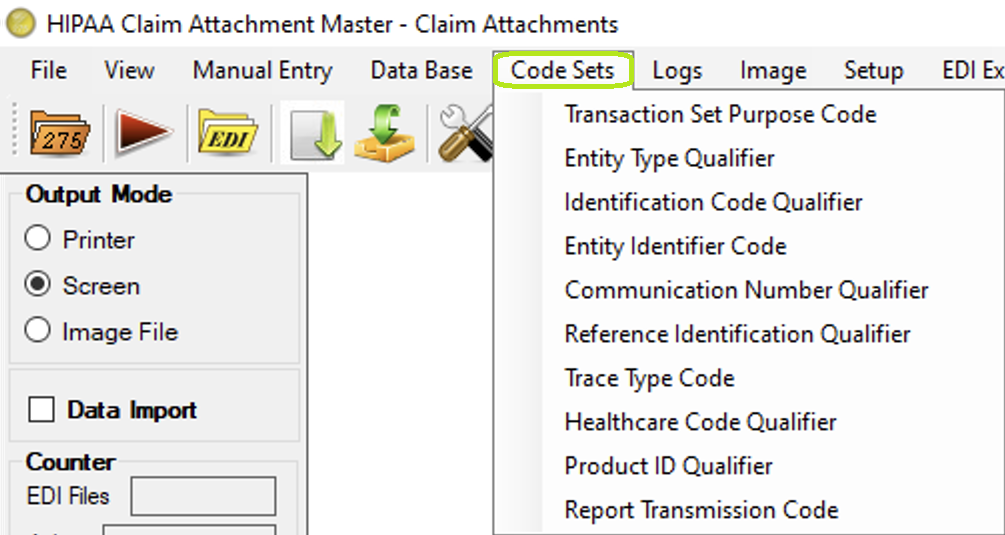
The "Code Sets" tab.
2.Hover the pointer over one of the sub-menus, then select your desired code set name. The following items are available per sub-menu:
·Transaction Set Purpose Code
·Entity Type Qualifier
·Identification Code Qualifier
·Entity Identifier Code
·Communication Number Qualifier
·Reference Identification Qualifier
·Trace Type Code
·Healthcare Code Qualifier
·Product ID Qualifier
·Report Transmission Code
The following screenshot illustrates how to select the "Transaction Set Purpose Code" code set for display.
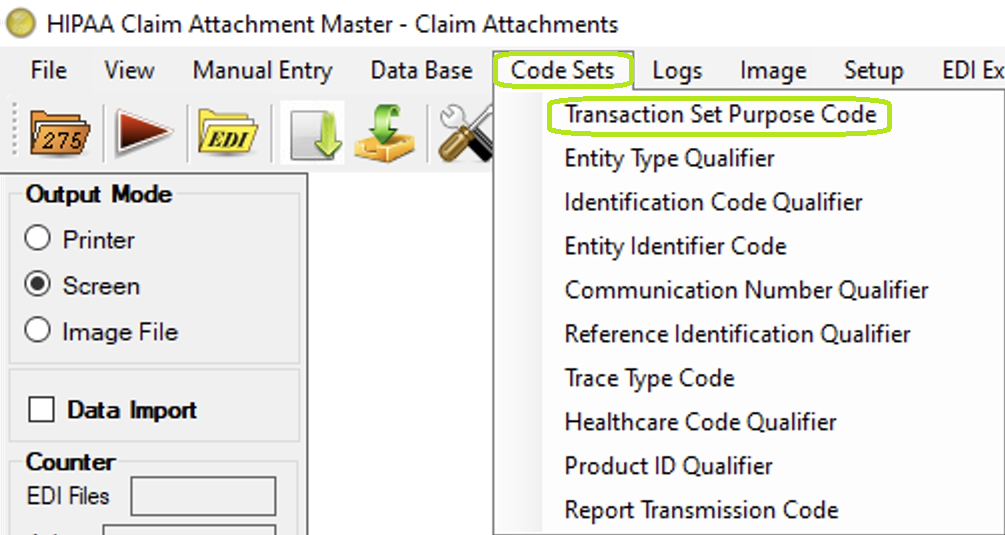
The "Transaction Set Purpose Code" option.
3.The code set configuration window will open.
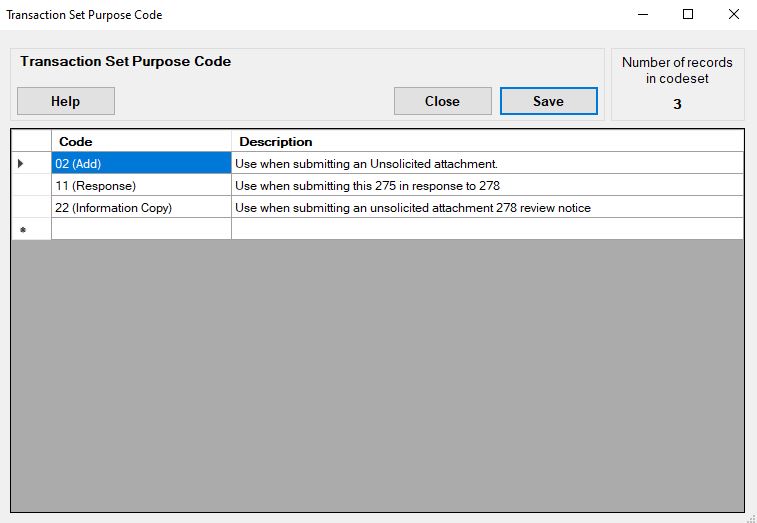
The "Transaction Set Purpose Code" code set window.
4.Once done, click "Save" if you have made any changes or "Close" if you want to exit. If you need more information, click "Help."
See the descriptions of the tools and actions you can find and perform, respectively, in the transaction code set lists:
This shows the total number of codes; in this example, the "Transaction Set Purpose Code" code set has 3 total codes.
The codes are indicated in the source EDI files. The descriptions are displayed instead of codes, making files easier to read. For example, for the "Transaction Set Purpose Code" code set, these are the codes and corresponding descriptions:
o02 (Add) — Use when submitting an Unsolicited attachment.
o11 (Response) — Use when submitting this 275 in response to 278
o22 (Information Copy — Use when submitting an unsolicited attachment 278 review notice
To add a row, click on the last row; you will see an indicator in the first gray field.

The indicator is shown in the left column.
To edit, double-click the cell you want to change. You may also start typing to enter Edit mode as well. Clicking or moving outside this cell overwrites the cell contents with the new value. To make these changes permanent, click the "Save" button.

Click on the cell you want to write.
To delete a row, click the left margin. This action will highlight the whole row. Then, press the Delete key on your keyboard.

Now press the <DELETE> key on your keyboard.