Configuring Image Setup |
  
|
Configuring Image Setup |
|
Images created with the HIPAA 999 Master application may be set up according to the user's needs. To complete this configuration, follow the steps below:
1.Select Image > Image File Options in the main menu window.
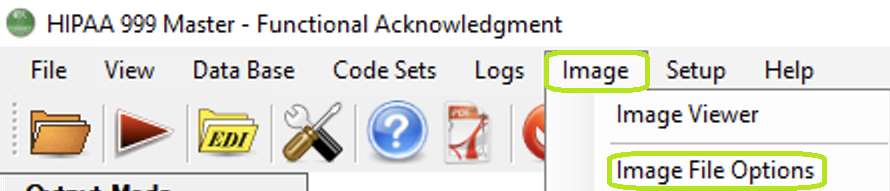
The "Image File Options" menu.
The following window will open:
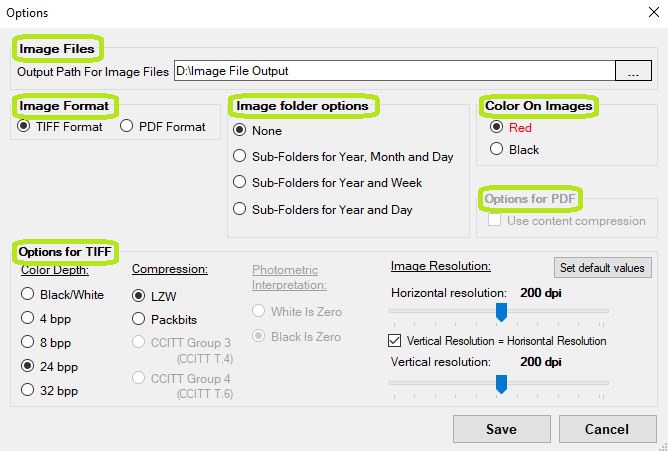
The "Image File Options" window.
2.After making your edits, click "Save."
See the details of each specific option below:

The "Image Files" box.
This box contains specific options regarding the storage and creation of image files. See the settings below:
oOutput Directory for Image Files — Here, you must set the path to the folder where the image files will be saved.
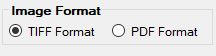
Sample image of how to create a hierarchy.
You may choose either PDF (Portable Document Format) or TIFF (Tagged Image File Format) as Implementation Acknowledgment formats. These are the most widely used image formats.
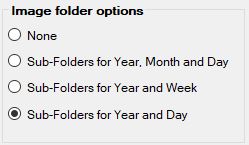
The "Image Folder Options" box.
When you create image files of Implementation Acknowledgments, you could soon end up with thousands of images in one folder. Windows has real problems with folders containing more than 1,000 files. For this reason, the HIPAA 999 Master application can hash the images over many folders to ensure that file quantities per folder remain low.

Folders may be sorted into year, month, and day folders and subfolders.
As shown, there is a folder with the year 2025 under the Output directory, then sub-directories with the month which are further subdivided into days of the month. The "2025/December/23" folder contains all the images created that day.
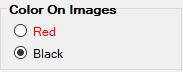
You may choose between Red or Black as a document's color.
This section of the setup window manages the output colors. The form background can be set to red to make the form more visually appealing and to allow the use of a color filter for OCR software.
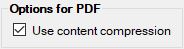
The "Options for PDF" box.
oUse Content Compression — Checking this option results in considerably smaller files. You can choose to compress the content, thereby reducing the file size by roughly 50%.
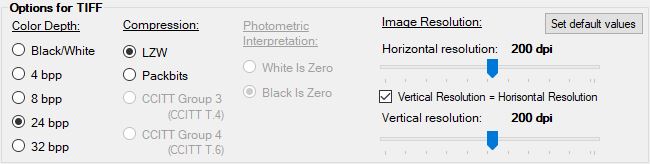
This box allows you to modify TIFF settings.
Here you can adjust the settings of TIFF image files, see the details for each below:
Color Depth
You can change the color depth of the image by selecting the number of bits per pixel (bpp):
oBlack/White (The black-and-white (bi-level) image means that for each pixel (picture element) in the image, we do not need three bytes as in the true color image (over 16.7 million colors), but only one bit that is 1/24 part of the pixel size from the true color image. The one-bit pixel can express only black or white colors, nothing more.)
o4 bpp
o8 bpp
o24 bpp
o32 bpp
Note: TIFF in the Windows GDI library does not work with 16 bpp. Color depths set lower than 16 bpp will result in some losses in image quality.
Compression
You can compress TIFF files to optimize space; LZW and Packbits are used for all colors; CCITT Group 3 and 4 are only available for black-and-white.
oLZW — You can compress any TIFF image of any bit depth using LZW, a lossless compression method. The application can store the compressed image in a TIFF file or keep it in memory. An average 2:1 compression ratio is achieved with LZW compression on images.
oPackbits — You can compress and decompress grayscale, palette, and bitonal images using Packbits—another lossless compression method. Packbits are fast, widely supported, and provide good compression of sparse images, such as scanned documents. The application can store the compressed image in a TIFF file or keep it in memory.
Photometric Interpretation
For the black-and-white and grayscale images, when "Black/White" or "4 bpp" options are selected as color depth, you can specify the intended interpretation of the image pixel data. Select one of the following options:
oWhite is Zero — The minimum sample value is displayed as white.
oBlack is Zero — Default value; the minimum sample value is displayed as black.
Image Resolution
You can change the horizontal and vertical resolution of images from 96 to 300 dpi (dots per inch). The default resolution is 200 dpi. The same rule applies here: the larger the resolution, the more computing time and power are consumed and, therefore, the larger the image file sizes.
oVertical Resolution = Horizontal Resolution — If this box is checked, the horizontal and vertical resolutions will have the same dpi.
Note: Choosing a higher resolution will slow down processing significantly and affect the final quality.
If you want the selected values as default, you may click "Set default values" to keep the settings the same for all images created in the future.