What is EDI |
  
|
What is EDI |
|
An Electronic Data Interchange (EDI) file is a data file that allows for the exchange of information in an efficient, cost-effective way between computers without the need of human interaction. EDI functions through a defined set of standards for transmitting information, allowing data to be interpreted correctly, regardless of the platforms used for data transmission.
EDI files are structured with the American Standard Code for Information Interchange (ASCII) standard, which is under the X12 chapter of the American National Standards Institute (ANSI). All the content of a transmission consists of ASCII characters. ASCII, or text files, can be viewed and edited with a regular text editor. However, since EDI files do not create line breaks (line feeds and carriage returns) to mark the end of a line, an EDI file is too complex to understand, as shown in the following example:
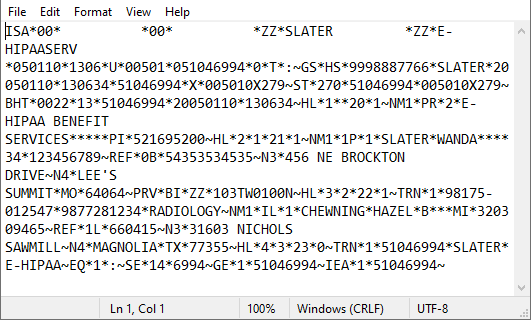
A view of raw EDI data.
As shown in the sample, it is too complex to discern the individual data elements within the ASCII text file. For this reason, HIPAAsuite developed the HIPAA Compliance Editor, a tool that conveniently formats and transforms complex, raw EDI files into easily readable files. Here is what the previous file looks like with the editor:
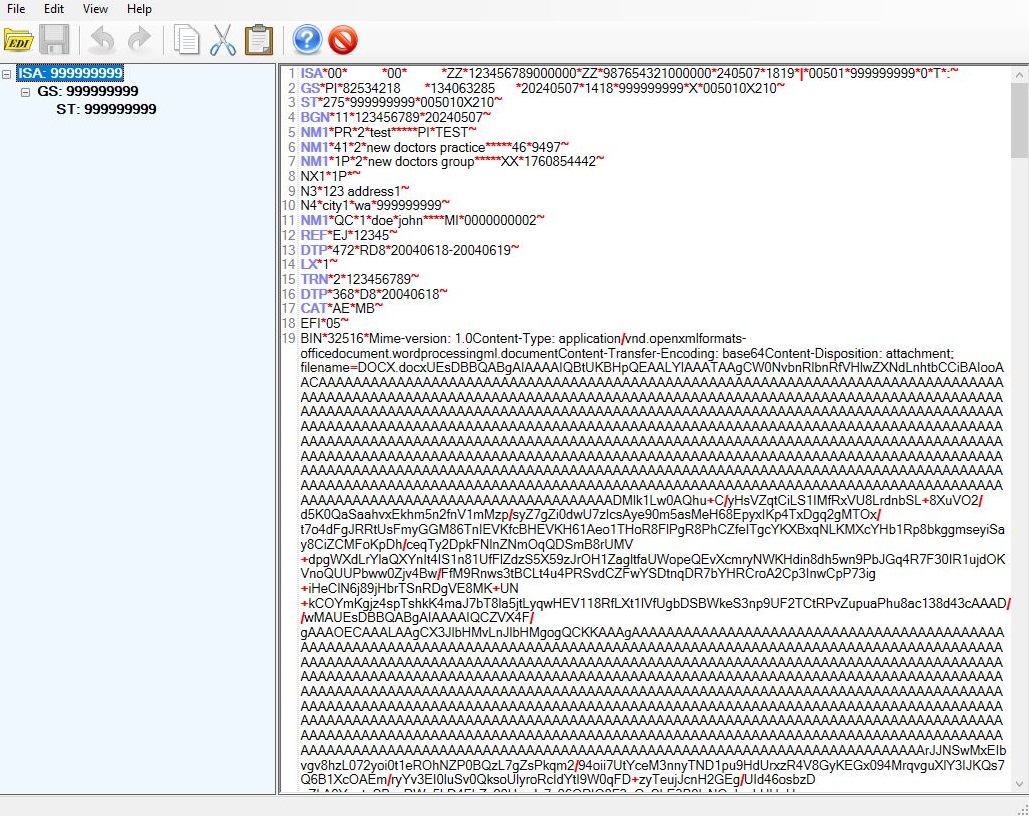
A view of EDI data with the HIPAAsuite Compliance Editor.
The Compliance Editor treats segments like lines, with color-coded segment identifiers and visible separators. A tree view control panel allows for easy navigation by showing envelope segments and main loops, such as CLM and CLP, among others. It also has tools, such as Find, Replace, Copy, Cut, and Paste to make editing easier.