|
<< Click to Display Table of Contents >> Monetary Fields |
  
|
|
<< Click to Display Table of Contents >> Monetary Fields |
|
The way the 271 transaction represents benefits is worth looking into. Benefits are represented by the EQ segment of the 271. It might take up to 12 EB segments to completely describe a benefit for a single service type code. With over 200 Service Type Codes this will become a huge 271 response. Here is why. You have first one EB segment to describe the benefit with the EligibilityStatus of "A" and then other EB segments for deductibles and patient responsibilities.
We decided that every benefit/ service type code should be represented by a single row in the EDI_CoveredBenefits table. Therefore we need to make sure all possibilities are accounted for, the alternative being a multitude of rows representing a single ServiceTypeCode and its various combinations of coverage level, deductibles, co-pay and co-insurance amounts. This means all Family or Individual-specific payment amounts and deductibles have to be represented in this single benefit record, even those for different out of network coverage. A number of fields are provided for this and cover Annual Deductible, Remaining Annual Deductible, and Remaining Benefit Specific Deductible for both individual and family coverage both in and out of network. These fields also include co-pay and co-insurance both in and out of network.
Deductibles:
• AnnualDedInNetworkIND, the annual deductible for individuals with in-network providers
• AnnualDedInNetworkFAM the annual deductible for families with in-network providers,
• AnnualDedOutNetworkIND the annual deductible for individuals with out-of-network providers
• AnnualDedOutNetworkFAM the annual deductible for families with out-of-network providers
Remaining Deductibles
• RemainingAnnualDedInNetworkIND, the remaining annual deductible for individuals with in-network providers
• RemainingAnnualDedInNetworkFAM the remaining annual deductible for families with in-network providers
• RemainingAnnualDedOutNetworkIND the remaining annual deductible for individuals with out-of-network providers
• RemainingAnnualDedOutNetworkFAM the remaining annual deductible for families with out-of-network providers
• RemainingBenefitDedInNetworkIND the remaining benefit specific deductible for individuals with in-network providers
• RemainingBenefitDedInNetworkFAM the remaining benefit specific deductible for families with in-network providers
• RemainingBenefitDedOutNetworkIND, the remaining benefit specific deductible for individuals with out-of-network providers
• RemainingBenefitDedOutNetworkFAM, the remaining benefit specific deductible for families with out-of-network providers
Co-pay:
• CoPayInNetworkQual, the time qualifier for the Co-pay for in-network providers
• CoPayInNetwork, the co-pay amount for in-network providers
• CoPayOutNetworkQual, the time qualifier for out-of-network providers.
• CoPayOutNetwork, the co-pay amount for out-of network providers.
Co-Insurance:
• CoInsuranceInNetwork, the co-insurance payment for in-network providers
• CoInsuranceOutNetwork , the co-insurance payment for out-of-network providers
When you deploy the HIPAA Eligibility Responder and you have to fill the covered Membership tables, be aware that each of those fields translates into a complete EB segment.
Below is an example of a testing data member's eligibility and benefit information grouped by each item's Service Type Code.
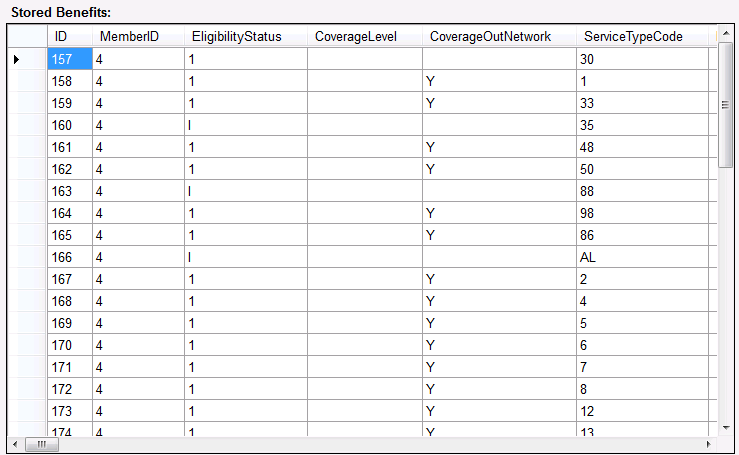
Test Bed Data Member example Frank Castillo's Benefits.
Below is an excerpt highlighting the multiple benefit coverage option fields as would be filled in a typical covered member's set of eligibility rows depicting the Status of each benefit, its Service Type Code, and deductible information.
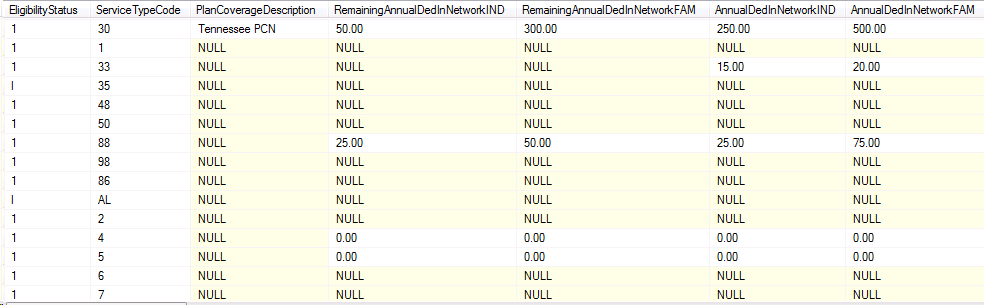
Deductibles for plan and benefits.