Application Setup |
  
|
Application Setup |
|
1.To configure the application, go to Setup > Application Setup in the main menu window or the "Options" button in the task menu.

The "Setup" menu and "Application Setup" button.
2.When you click on "Application Setup," the following screen comes up:
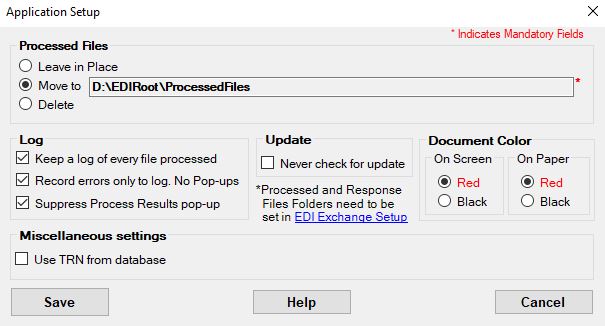
The Application Setup screen.
Processed Files
The first setting concerns the handling of EDI files after processing. In order to avoid the duplicate processing of EDI files, we recommend that you move files after processing into an archive folder so that they are not processed multiple times. When working with copies of files, you can choose to delete the copies after processing. Always ensure that the original files are saved in a secure location. EDI files are important business documents and you want to make sure that you can access them at a later point in time for troubleshooting, audits, and other reasons. Leave in Place means the file remains in its original location and is not moved or deleted after processing.

Determining the handling of processed files.
If you use EDI Exchange, the Processed File folder is given by the folder schema of EDI Exchange where each trading partner has a place for their folders.
Log
The next item is the log. The HIPAA Eligibility Checker keeps track of all the step of processing EDI files. When it is run through the command line, those messages will be saved in the log.
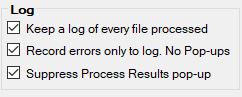
The log setting determines whether process messages will be saved to the log file at all times.
Checking the above check box ensures that all process messages are written to the log file regardless whether the application is run through the command line or the user interface.
Update
The next item determines whether the application on start-up looks for the existence of updates and newer version. Some companies have a strict policy that all updates have to be thoroughly tested before they can be implemented and users should not be faced with an option of update the application. For this case we have the below check mark.
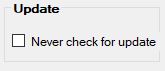
Set if you want to suppress update messages.
Document Color
The next item on the setup screen determines whether the back ground and labels on the printable form are in red to contrast them with the font color of black. When printing the forms to paper on a color printer you can save money and resources by choosing black. Otherwise it makes the forms much easier to read when you have background and labels in red.
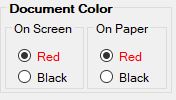
Set the color of document background and labels.
Miscellaneous settings
The last item determines the use of TRN from the database. If the box displays a check mark, data is being used from the TRN segment within the database. If not check marked, new data will be generated.

Set which ID you want generated.